
Sole Proprietor vs. LLC vs. S Corporation: Which Business Structure Is Right for You?
Starting a business comes with a long list of decisions, but one of the most important is choosing your business structure. The way your business is set up affects your taxes, legal liability, paperwork, and even how you pay yourself.
Many entrepreneurs begin as sole proprietors because it's quick and simple. As their business becomes more profitable, they often ask:
"Should I form an LLC?"
Or even,
"Is it time to become an S corporation?"
Let's look at what each option means and, more importantly, how it impacts your taxes.

Sole Proprietorship: Simple to Start, But It Has Limitations
A sole proprietorship is the default business structure if you're operating a business by yourself without registering a separate legal entity with your state.
Many freelancers, consultants, pet sitters, photographers, and other service-based businesses begin this way because there's very little required to get started.
Pros
Easy and inexpensive to start
Minimal paperwork
Business income is reported on your personal tax return
Simple tax filing
Tax Implications
As a sole proprietor, you'll report your business income and expenses on Schedule C of your personal tax return.
After deducting your business expenses, your net profit is generally subject to:
Federal and state income tax (where applicable)
Self-employment tax
Self-employment tax covers your Social Security and Medicare contributions and is currently 15.3% on applicable earnings. Because you're both the employer and the employee, you're responsible for both portions of these taxes.
As your profits grow, so does your self-employment tax bill.
LLC: Liability Protection with Flexible Tax Options
A Limited Liability Company (LLC) is a legal business entity created through your state. One of its biggest benefits is helping separate your personal assets from your business liabilities.
Whether you own a veterinary clinic, operate a doggy daycare, or run a home service business, this added legal protection is often an important consideration.
Pros
Personal liability protection
Flexible ownership structure
Greater business credibility
Ability to choose how you're taxed
Tax Implications
Here's one of the biggest misconceptions about LLCs:
Forming an LLC doesn't automatically lower your taxes.
A single-member LLC is generally taxed the same as a sole proprietorship unless you elect a different tax classification.
That means:
Your business income still flows through to your personal tax return.
You'll generally continue paying self-employment tax on your business profits.
Think of it this way:
An LLC changes your legal structure, not necessarily your tax structure.
S Corporation: A Tax Strategy for Growing Businesses
Unlike an LLC, an S corporation is a tax election made with the IRS. Many small business owners first form an LLC and later elect S corporation taxation once their business reaches a consistent level of profitability.
Pros
Potential self-employment tax savings
Pass-through taxation
Can become more tax-efficient as profits increase
Tax Implications
With an S corporation, you're typically both an owner and an employee of your business.
Instead of taking all of your earnings as business profit, you generally receive:
A reasonable salary paid through payroll
Additional profits distributed as shareholder distributions
Your salary is subject to payroll taxes, but qualifying distributions generally are not subject to self-employment tax.
A Simplified Example
Imagine your business earns $120,000 in profit for the year.
As a sole proprietor, the entire profit is generally subject to self-employment tax.
As an S corporation, you might pay yourself a reasonable salary of $70,000 and receive the remaining $50,000 as a distribution.
Because payroll taxes generally apply only to the salary portion, many business owners see meaningful tax savings when an S corporation election is appropriate.
However, those savings come with additional responsibilities, including:
Running payroll
Filing additional tax returns
Maintaining accurate bookkeeping
Keeping good records
Paying yourself a reasonable salary that complies with IRS guidelines
So...Which One Is Right for You?
The answer depends on your business, your goals, and your profits.
Here's a general comparison:
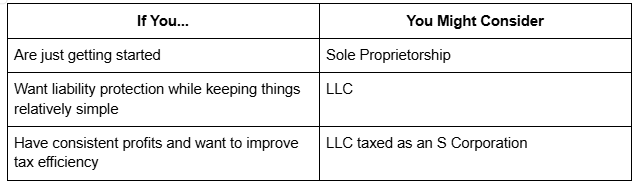
There's no magic profit number where an S corporation automatically makes sense. The right time depends on several factors, including your income, payroll costs, tax situation, and long-term goals.
Common Misconceptions
"An LLC automatically saves me money on taxes."
Not by itself. Without an S corporation election, a single-member LLC is generally taxed the same as a sole proprietorship.
"Every business should elect S corporation status."
Not necessarily.
An S corporation can offer tax savings, but it also brings additional administrative requirements and costs. For businesses with lower profits, those extra responsibilities may outweigh the potential tax benefits.
"I can pay myself whatever salary I want."
The IRS requires business owners who work in an S corporation to pay themselves a reasonable salary based on the services they provide. Setting your salary artificially low simply to reduce payroll taxes can raise red flags.

The Bottom Line
Your business structure isn't a "set it and forget it" decision.
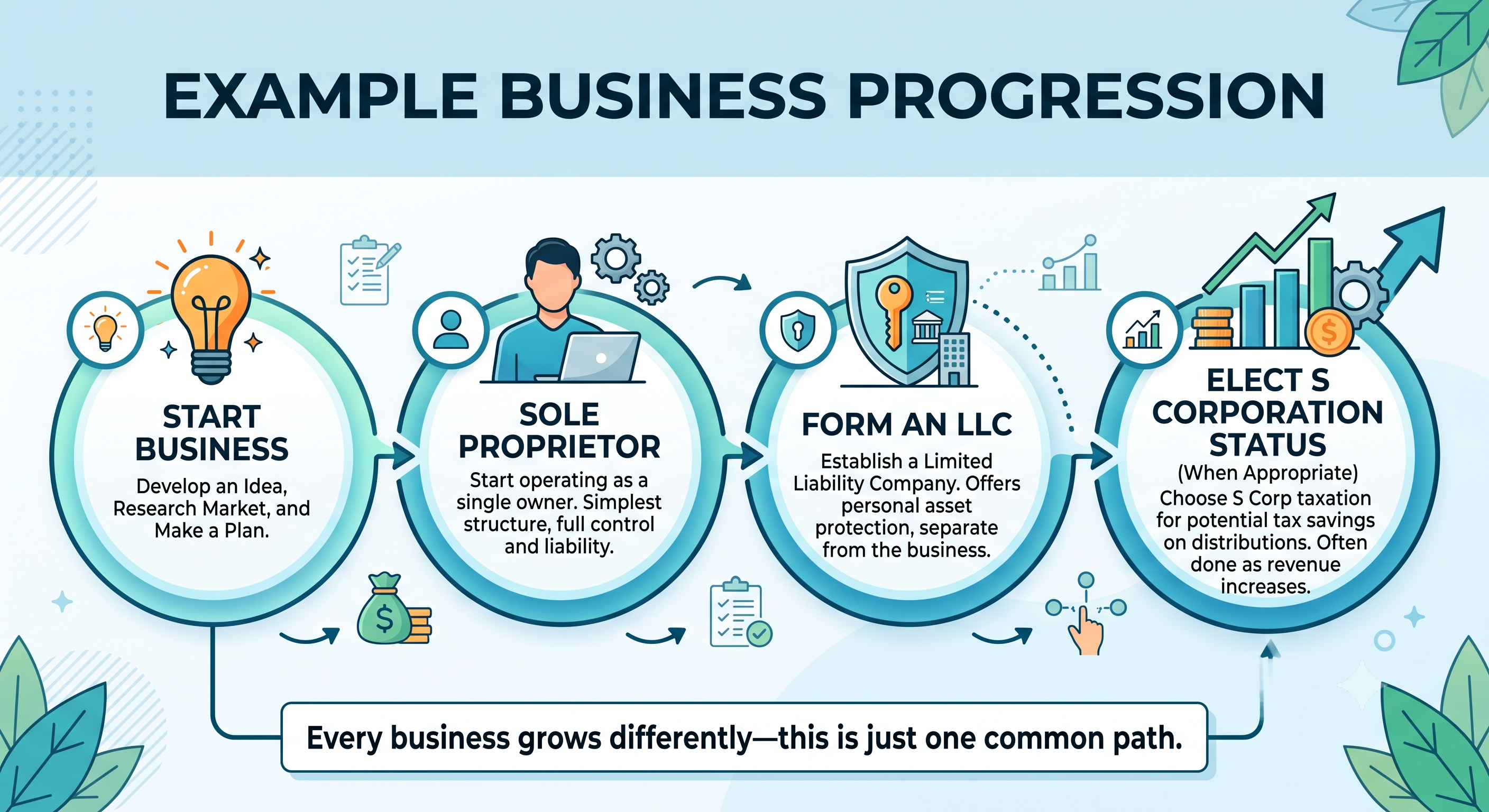
Many successful businesses start as sole proprietorships, transition to an LLC for liability protection, and eventually elect S corporation taxation when it makes financial sense.
The right choice depends on your unique situation, not what worked for another business owner.
If your business has grown significantly over the past year, now is a great time to review whether your current structure is still the best fit. A conversation with a trusted tax professional can help you understand your options, estimate potential tax savings, and avoid costly mistakes before they happen.
The goal isn't simply to pay less in taxes, it's to choose a structure that supports your business today while giving you room to grow tomorrow.