
Your Business Has Money, But Where Is It Going?
Have you ever looked at your business and thought:
“We made good money this month…so why doesn't it feel like we have any?”
You're not alone.
One of the biggest sources of confusion for small business owners is assuming that revenue, profit, and cash flow are basically the same thing.
They're not.
Your business may have strong sales but very little cash in the bank. You may show a profit on your financial statements but still feel like you're constantly scrambling to pay bills. Or you may have plenty of cash available today while your business isn't actually profitable.
Confusing? Absolutely.
But once you understand the difference between these three financial concepts, your numbers start to tell a much clearer story.
In this post, we'll break down revenue, profit, and cash flow in plain English, explain why all three matter, and help you better understand where your business's money is actually going.
First, Think of Your Business Money in Three Different Ways
Let's start with the simplest explanation:
Revenue tells you how much money your business earned.
Profit tells you how much money was left after business expenses.
Cash flow tells you where your actual money is moving.
Each number answers a different question.
And if you're only looking at one of them, such as your bank balance, you may not be getting the full picture.
Let's break them down.
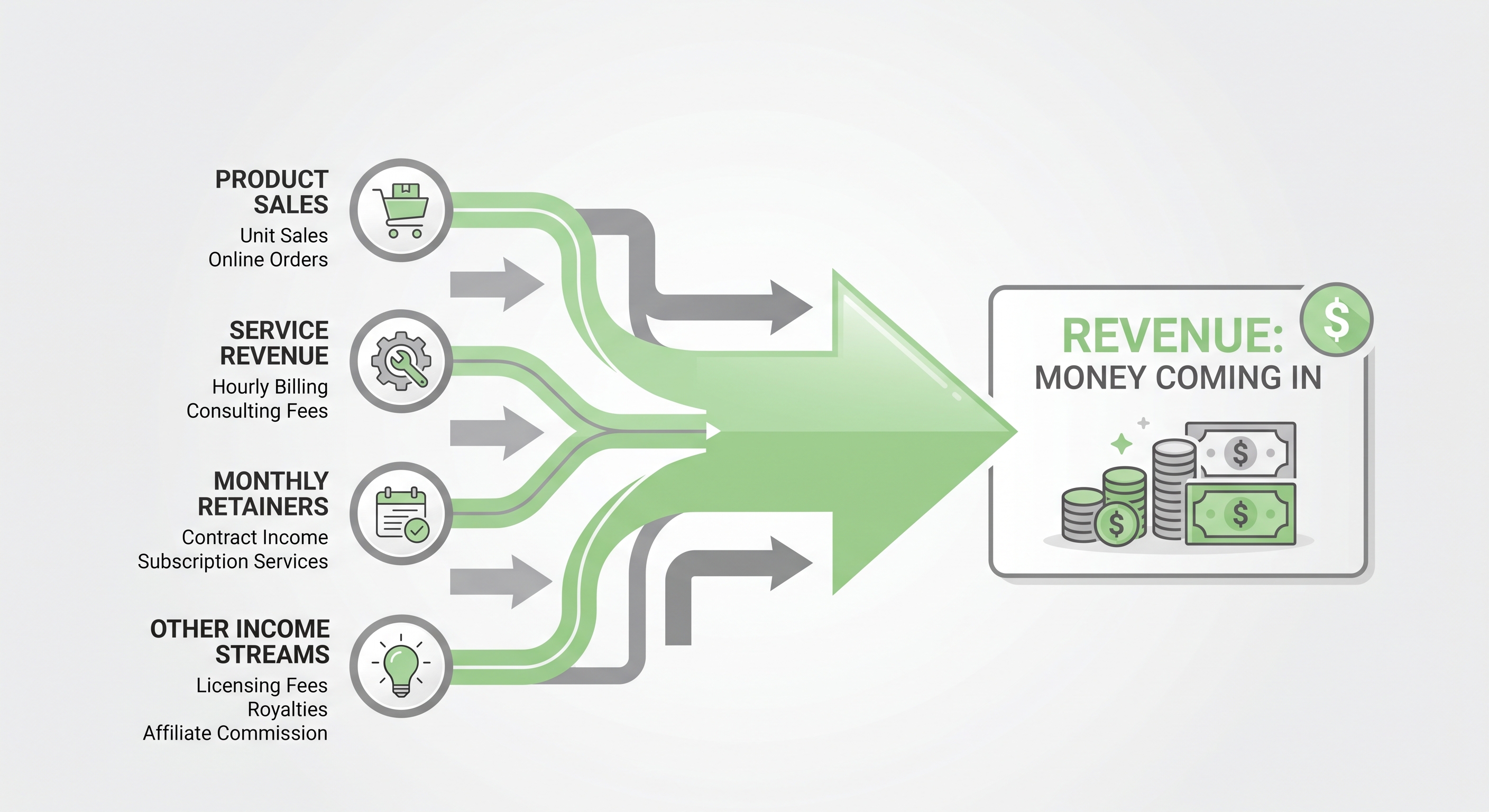
What Is Revenue?
Revenue is simply the money your business earns from its normal operations.
For example, let's say your business provides services and collects $25,000 from clients during the month.
Your revenue is:
$25,000
That's it.
Revenue does not tell you:
How much you spent to run the business
How much you owe in taxes
How much debt you have
How much you paid yourself
How much cash is sitting in your bank account
How much money you actually get to keep
Revenue answers one important question:
How much did my business generate?
Think of revenue as the top line.
It's an important measure of growth, but bigger revenue doesn't automatically mean a healthier or more profitable business.
A business generating $500,000 in revenue isn't necessarily doing better financially than a business generating $250,000.
The difference comes down to what happens to the money next.
What Is Profit?
Profit is what remains after you subtract your business expenses from your revenue.
The basic formula is:
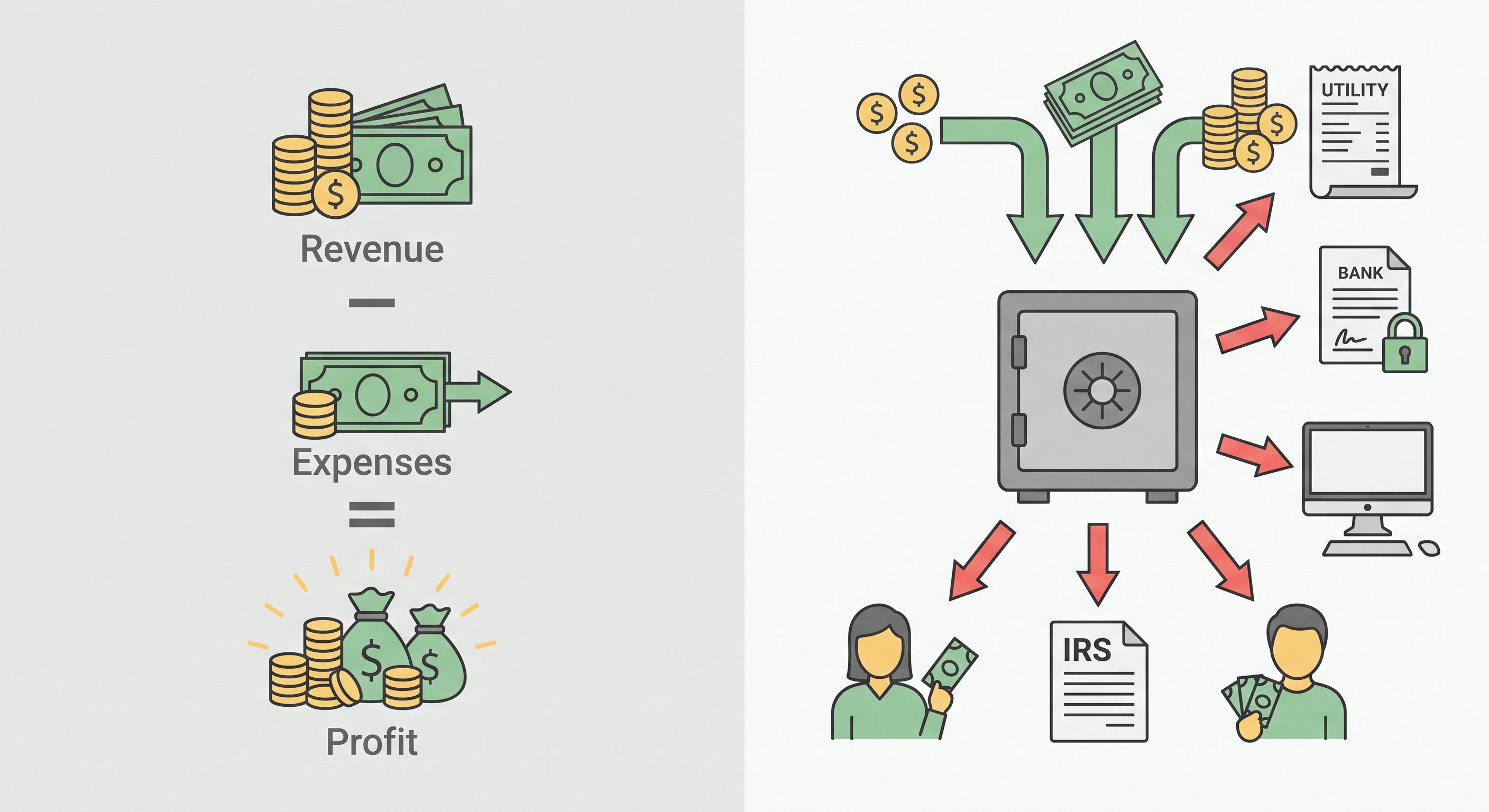
Revenue – Expenses = Profit
Let's go back to our example.
Your business earned $25,000 in revenue for the month.
During that same period, you had:
Payroll: $8,000
Rent and utilities: $2,000
Software and subscriptions: $1,000
Marketing: $2,000
Supplies and other expenses: $4,000
Your total expenses were $17,000.
That leaves:
$25,000 Revenue – $17,000 Expenses = $8,000 Profit
That $8,000 represents the profitability of your business for that period.
In other words, your business generated more revenue than it spent on expenses.
Profit answers the question:
“Is my business actually making money?”
This is why looking at revenue alone can be misleading.
Imagine two businesses:
Business A
Revenue: $500,000
Expenses: $475,000
Profit: $25,000
Business B
Revenue: $300,000
Expenses: $225,000
Profit: $75,000
Business A brought in significantly more revenue.
But Business B actually made more profit.
More sales don't always equal more money in your pocket.
So, If My Business Is Profitable, Why Is There No Cash?
This is where cash flow comes in.
Cash flow tracks the actual movement of money into and out of your business.
And here's the important part:
Profit and cash are not the same thing.
A business can be profitable on paper and still experience cash flow problems.
Let's say your business earns a $50,000 profit for the year.
You might assume there should be an extra $50,000 sitting in your bank account.
But what if, during the year, you also used cash to:
Pay down a business loan
Purchase equipment
Buy inventory
Pay taxes
Repay money you previously borrowed
Make owner distributions or draws
Pay bills from prior months
Build up accounts receivable because customers haven't paid yet
Those transactions affect your cash.
But they don't all affect profit in the same way.
That means your business can be profitable while your bank account tells a very different story.
A Simple Example: Where Did the $10,000 Go?
Let's say your business generated a $10,000 profit this month.
Great news!
But when you look at your bank account, you only see $3,000 more than you had at the beginning of the month.
What happened to the other $7,000?
It may have gone toward things such as:
$2,000 for a loan payment
$2,500 for new equipment
$1,500 toward taxes
$1,000 in additional inventory
Your business may still have earned a $10,000 profit.
But the cash was used for other purposes.
That's the difference.
Profit tells you whether your business earned more than it spent.
Cash flow helps explain where the actual money went.
Why Your Bank Balance Doesn't Tell the Whole Story
It's tempting to manage your business based on one number:
Whatever is currently in the bank account.
But your bank balance doesn't automatically tell you:
How much of that money is already needed for upcoming expenses
Whether you owe taxes on the income you've earned
Whether you've actually been profitable
Whether customers still owe you money
Whether a large deposit is payment for future work
Whether you have enough cash to cover upcoming payroll or bills
For example, seeing $30,000 in your bank account might feel great.
But what if:
$10,000 is needed for payroll
$5,000 is set aside for taxes
$7,000 is needed for upcoming bills
$3,000 belongs to a client refund or deposit you haven't earned yet
Suddenly, that $30,000 doesn't mean you have $30,000 available to spend.
This is why understanding your cash position is more important than simply checking your bank balance.
How Revenue, Profit, and Cash Flow Work Together
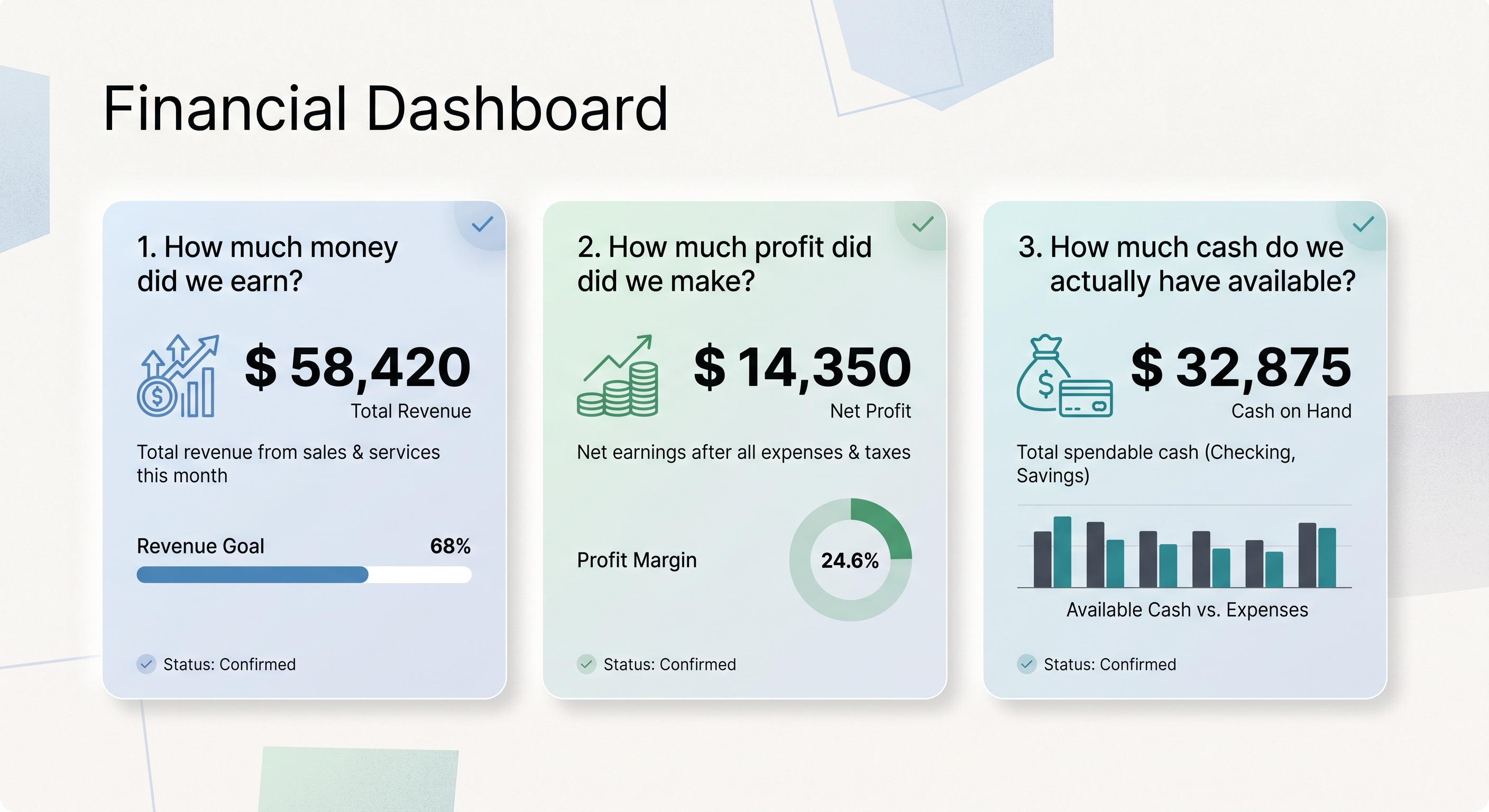
The easiest way to think about these three numbers is to remember that they each answer a different question.
1. Revenue: How much money did we earn?
Revenue helps you measure:
Growth
Sales performance
Demand for your products or services
Progress toward your revenue goals
2. Profit: How much money did we make?
Profit helps you understand:
Whether your business model is financially sustainable
Whether your pricing is working
Whether expenses are too high
How efficiently your business operates
3. Cash Flow: Where is the money going?
Cash flow helps you manage:
Payroll
Bills
Taxes
Debt payments
Equipment and inventory purchases
Owner compensation
Short-term financial needs
You need all three to understand the financial health of your business.
Three Questions to Ask Every Month
You don't need to become an accountant to start understanding your numbers.
Begin by asking yourself these three questions each month:
1. How much revenue did my business generate?
Look at your income for the month.
Then compare it to:
Last month
The same month last year
Your monthly revenue goal
2. Was my business profitable?
Review your Profit and Loss Statement.
Ask:
Did we make a profit?
Is our profit margin improving?
Which expenses increased?
Are we spending money in areas that are producing results?
3. What happened to our cash?
Look beyond your bank balance.
Consider:
Did we pay down debt?
Did we purchase equipment or inventory?
Are customers taking longer to pay?
Did we make large tax payments?
Did we take owner draws or distributions?
Are we preparing for upcoming expenses?
When you start reviewing these three areas together, you'll begin to see the complete financial picture.
Good Bookkeeping Helps You Follow the Money
If you regularly find yourself wondering, “Where did all the money go?”, the issue isn't necessarily that your business isn't making enough.
You may simply not have enough visibility into your financial activity.
Accurate, up-to-date bookkeeping helps you separate the story into the numbers that actually matter.
Instead of guessing based on your bank balance, you can see:
What your business earned
What your business spent
Whether you're profitable
What expenses are increasing
Where cash is being used
What financial obligations may be coming next
The goal isn't just to have clean books at tax time.
The goal is to understand what's happening in your business while you still have time to make decisions.
The Bottom Line: Follow the Story, Not Just the Money
Revenue is exciting.
Profit is important.
But cash flow is what keeps your business moving.
When you understand the difference between all three, you can stop asking, “Where did all my money go?” and start finding answers.
The next time you review your business finances, don't stop at your bank balance.
Ask yourself:
How much did we earn?
How much did we make?
And where did the cash go?
Those three questions can give you a much clearer picture of what's really happening behind the numbers.
Ready to better understand your business finances?
Start with your most recent month of bookkeeping and compare your revenue, profit, and change in cash. You may be surprised by what the numbers reveal.
And if you know another business owner who's ever looked at a healthy bank balance, or an empty one, and wondered, “How did we get here?”, share this article with them.
Looking for more support, visit c-squaredaccounting.com.