
Are Your Prices Actually Profitable? How to Use Your Numbers to Find Out
When was the last time you looked at one of your prices and asked, “Is this actually profitable?”
Not “Are customers willing to pay it?”
Not “Is this what everyone else charges?”
And not even “Does this cover my expenses?”
I'm talking about whether the price you're charging leaves enough money behind to make the work worthwhile and contribute to the profitability of your business.
It's easy to assume that higher revenue means you're becoming more profitable. But that's not always the case.
You can have a busy business, plenty of customers, and increasing revenue while your profit margins continue to shrink.
The good news? You don't have to guess.
Your financial numbers can help you determine whether your prices are working and where you may need to make adjustments.
Let's look at three numbers that can tell you a lot: revenue, direct costs, and margins.
Revenue Is Only the Starting Point
Let's start with the number most business owners naturally pay attention to: revenue.
Revenue is the money your business brings in from selling its products or services.
If you charge $500 for a service and sell 10 of them, you've generated:
$500 × 10 = $5,000 in revenue
That sounds great.
But there's a problem with stopping there.
Revenue isn't profit.
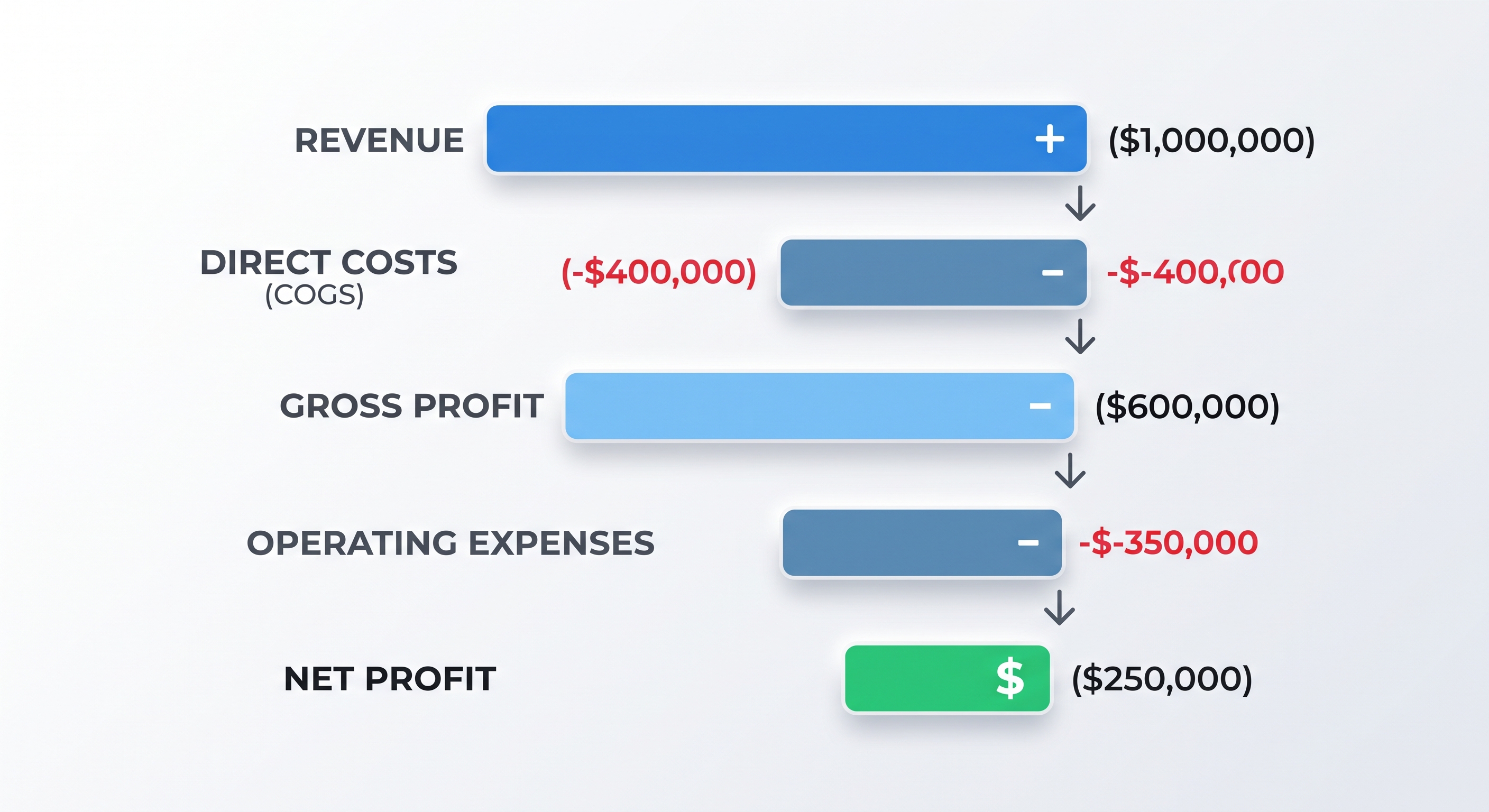
You still have to pay the costs associated with delivering those services, along with the other expenses required to operate your business.
This is why a business generating $500,000 in revenue isn't necessarily more profitable than one generating $300,000.
The real question is:
How much of that revenue is left after the costs of generating it?
That's where direct costs and margins come into the conversation.
Step 1: Identify Your Direct Costs
Direct costs are expenses that are directly tied to providing a particular product or service.
Think about what you have to spend because you made the sale or performed the service.
Depending on your business, that might include:
Materials or supplies
Product costs
Payment to a subcontractor who performs part of the work
Labor directly associated with delivering a service
Shipping or delivery costs
Certain transaction or processing fees
Other costs that increase as you sell more
For example, imagine a pet care business charges $100 for a particular service.
The business has $30 in direct costs associated with providing that service.
That means:
$100 revenue – $30 direct costs = $70 gross profit
That $70 isn't the owner's take-home pay. The business still has other expenses to cover.
But that $70 is what the service contributes toward those expenses and ultimately toward profit.
That's important information when you're evaluating your pricing.
Step 2: Calculate Your Gross Margin
Now let's take this one step further.
Gross profit tells you the dollar amount left after direct costs.
Gross margin tells you that amount as a percentage of revenue.
Using our example:
Price: $100
Direct costs: $30
Gross profit: $70
Your gross margin would be:
$70 ÷ $100 = 70% gross margin
That percentage can help you compare different products or services even when their prices are very different.
For example:
Service | Price | Direct Costs | Gross Profit | Gross Margin |
|---|---|---|---|---|
Service A | $100 | $30 | $70 | 70% |
Service B | $200 | $80 | $120 | 60% |
Service C | $500 | $150 | $350 | 70% |
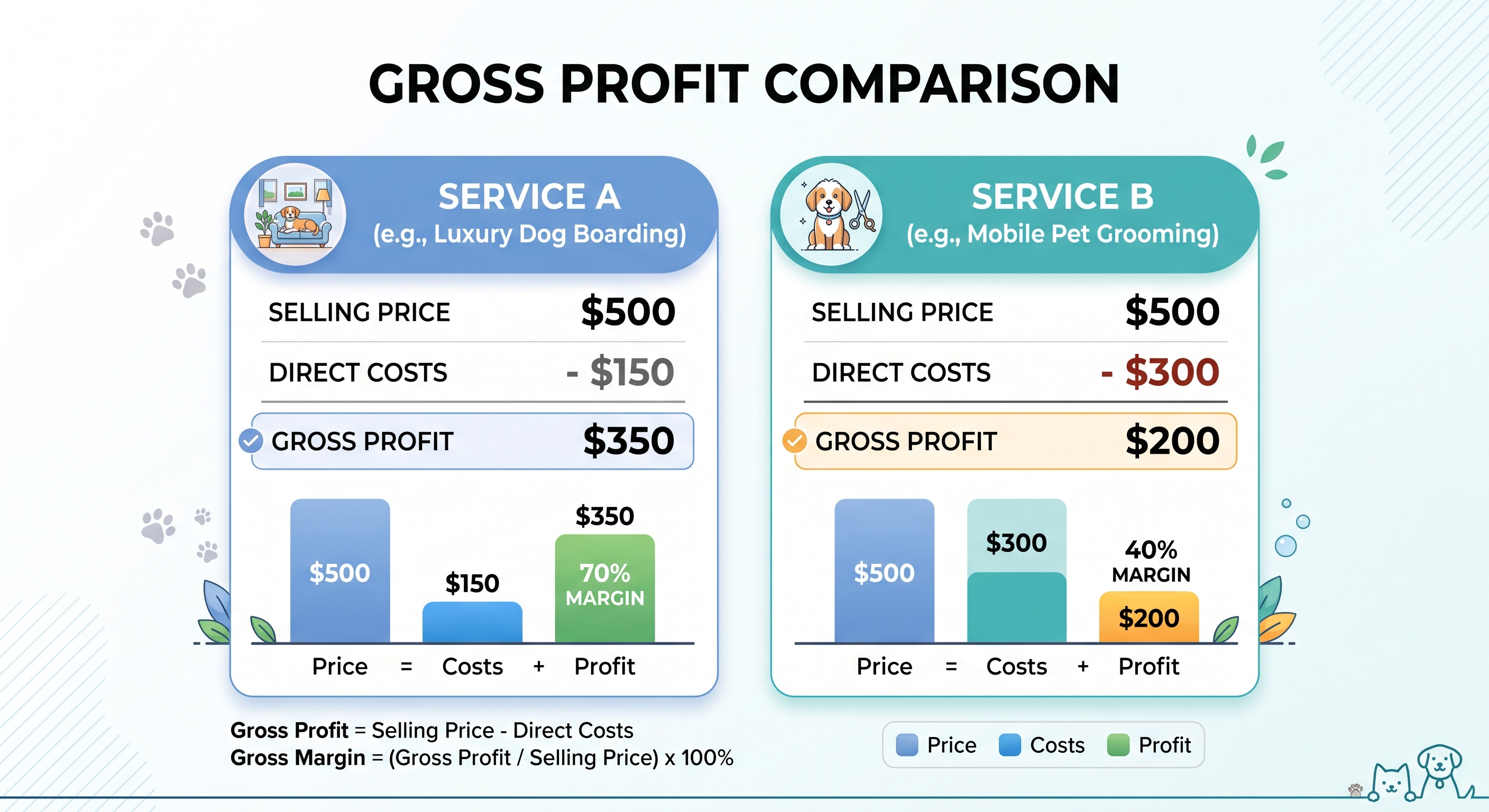
At first glance, Service C looks like the clear winner because it generates $350 of gross profit per sale.
But Service B may still be valuable depending on how long it takes to deliver, how frequently customers purchase it, and how much capacity it requires.
This is why pricing can't be evaluated using one number alone.
Step 3: Consider What Happens After Gross Profit
Here's where pricing gets even more interesting.
Your gross profit has to help cover the costs of actually running your business.
These might include:
Rent
Insurance
Software
Marketing
Professional fees
Administrative expenses
Office expenses
Business licenses
Owner compensation
Other overhead
Let's say your business generates $20,000 in revenue in a month.
You have $7,000 in direct costs, leaving you with:
$13,000 gross profit
That sounds pretty good.
But if your operating expenses are $11,000, you're left with only:
$2,000 in profit
That's a 10% net profit margin.
Suddenly, that $20,000 revenue number looks a little different.
This is why it's important to look beyond sales when evaluating whether your pricing is working.
Step 4: Ask What Each Sale Actually Contributes
One of the most useful questions you can ask is:
“After the costs directly associated with this sale, how much money is left to contribute toward the rest of my business?”
This helps you understand the economic value of each product or service.
Let's say you offer three services:
Service A generates $50 of gross profit
Service B generates $100
Service C generates $250
If Service C takes twice as long to deliver as Service B, however, the comparison changes.
You may discover that Service B produces a better return on your time.
That's why I don't recommend looking at your pricing in isolation.
Consider:
Price → Direct Cost → Gross Profit → Gross Margin → Time/Capacity
Together, these numbers give you a much clearer picture.
Step 5: Look for Your Low-Margin Offerings
Once you've calculated the numbers for your products or services, look for patterns.
You may discover that some of your offerings have significantly lower margins than others.
That doesn't automatically mean you need to eliminate them.
Instead, ask why.
Maybe the service:
Takes longer than you realized
Requires more supplies
Requires additional labor
Has a price that hasn't been updated in several years
Has become more expensive to deliver
Includes more work than you originally anticipated
Is frequently discounted
Requires a lot of administrative time
Sometimes the problem isn't that you're selling the wrong thing.
Your price simply hasn't kept up with the cost of delivering it.
Your Numbers Can Help You Decide What to Change
Once you understand your margins, you have several options.
Increase the Price
Sometimes the simplest solution is to raise the price.
If your costs have increased but your pricing hasn't changed, your margin may have quietly declined.
Reduce Direct Costs
Look for ways to deliver the same product or service more efficiently.
Can you negotiate with vendors? Reduce waste? Change processes? Use labor differently?
Even a small reduction in direct costs can improve your margin.
Change the Scope
Sometimes the issue isn't the price, instead it's what's included.
If you're consistently doing more work than the price accounts for, you may need to redefine the service.
Create Different Pricing Tiers
You might also offer different levels of service.
For example:
Basic → Standard → Premium
This gives customers choices while allowing you to capture additional revenue from customers who want more.
Discontinue or Redesign an Offering
And sometimes the numbers tell you that an offering simply isn't working.
That's not failure.
That's information.
A service that looked like a good idea when you introduced it may no longer make sense for your business today.
Don't Forget About Your Overall Profit Goal
There's one more important piece of the puzzle.
Your prices shouldn't only be based on what it costs you to deliver something.
They should also support the business you want to build.
Think about what you need your business to accomplish.
Maybe you want to:
Pay yourself consistently
Hire employees
Invest in equipment
Build cash reserves
Pay taxes without scrambling
Reduce your workload
Fund future growth
Generate a healthy profit
Your pricing plays a role in all of those goals.
If your prices only allow you to cover your costs, you don't really have room to build the business you want.
Profit isn't what happens if there's money left over. It should be part of the plan.
A Simple Pricing Profitability Check
You don't need a complicated financial model to start evaluating your prices.
Pick your top three to five products or services and calculate:
What do I charge?
What are the direct costs of delivering it?
How much gross profit does it generate?
What is the gross margin percentage?
How much time does it take to deliver?
Has my cost to deliver changed since I set the price?
Does this offering contribute enough toward my overall business goals?
Then look across your offerings.
You may be surprised by what you find.
The service you sell the most might not be your most profitable.
Your most expensive service might not have the best margin.
And the offering you thought was your “bread and butter” might actually be consuming a lot of your time while contributing relatively little to your bottom line.

Pricing Should Be a Financial Decision, Not a Guess
Pricing can feel personal.
You may worry about losing customers if you raise your rates.
You may compare yourself to competitors.
You may wonder whether customers will think you're too expensive.
Those are all valid considerations.
But they shouldn't be the only considerations.
Your financial statements can give you another perspective.
When you understand your revenue, direct costs, gross profit, and margins, you can make pricing decisions based on what your business actually needs, not just what you think customers might be willing to pay.
And that's a much more powerful place to make decisions from.
The Bottom Line
Your revenue number can tell you how much you're selling.
Your direct costs tell you what it takes to deliver those sales.
Your margins show you how much is left to help cover your operating expenses and generate profit.
Together, these numbers can help you answer an important question:
Are your prices actually supporting a profitable business?
If you haven't looked at your pricing this way recently, choose one product or service and run the numbers.
You might discover that your pricing is right where it needs to be.
Or you might discover an opportunity to make a change that has a meaningful impact on your bottom line.
Either way, your numbers are giving you information. The next step is using it.
What would happen if you evaluated just one of your prices this week?