
Got Contractors? Organize Your 1099 Records Now.
If you’ve hired an independent contractor this year, there’s one year-end task you don’t want to leave until January: getting your contractor records organized.
It’s easy to focus on paying your contractors and getting the work done. But when year-end arrives, you may also need to determine which payments must be reported to the IRS and prepare the appropriate tax forms.
The good news? You don’t have to wait until tax season to get started.
A little preparation now can help you avoid tracking down missing information, sorting through months of transactions, and scrambling to meet filing deadlines. Here’s what to review before the year ends.
1. Start With a List of Everyone You Paid
Before you worry about tax forms, get a clear picture of who provided services to your business during the year.
Think beyond contractors you hired directly. Depending on your business, your list might include:
Virtual assistants and administrative support
Freelance designers, writers, and marketing professionals
Consultants and business coaches
Independent subcontractors
Maintenance and repair professionals
Other service providers who worked for your business
Review your bookkeeping records, bank statements, credit card transactions, invoices, and payment platform reports to identify the people and businesses you paid.
Create a list that includes each contractor’s name, business name if applicable, type of service, payment method, and total payments for the year.
Why does this matter? You can’t determine your reporting obligations if you don’t know who you paid or how much you paid them.
This is also a good opportunity to check that contractor expenses have been recorded in the correct accounts in your bookkeeping system.
2. Collect a Form W-9 From Each Contractor
One of the most useful documents to have on file is Form W-9, Request for Taxpayer Identification Number and Certification.
A W-9 provides the contractor’s legal name, business name if applicable, federal tax classification, taxpayer identification number, and address. You use this information to help prepare the appropriate information return when required.
Ideally, you should request a completed W-9 before making your first payment to a new contractor.
If you haven’t been collecting them consistently, now is the time to review your records and request any missing forms.
Keep these tips in mind:
Verify the information is complete. Check that the name, address, and taxpayer identification information are provided.
Keep the form secure. W-9s contain sensitive information, so use a secure document storage system with appropriate access controls.
Avoid waiting until January. Contractors may be harder to reach during the holiday season or when you're trying to meet filing deadlines.
The IRS recommends keeping W-9s in your files for four years. See the IRS guidance on independent contractor forms.

3. Understand When Form 1099-NEC May Be Required
Form 1099-NEC, Nonemployee Compensation, is commonly used to report qualifying payments made to independent contractors for services performed for a business.
However, not every contractor payment automatically requires a 1099-NEC. The reporting rules depend on the type of payment, the recipient, how the payment was made, and the applicable tax-year requirements.
For payments made during 2026, federal law increased the general reporting threshold for certain payments from $600 to $2,000. Special rules and exceptions may apply, so confirm the requirements for the specific payment and recipient before filing.
For example, you may need to review payments to:
An individual freelancer who provides marketing services
A consultant who advises your business
A subcontractor who performs services for your customers
A service provider operating through a business entity
The recipient's business structure matters, but don't assume that every corporation is exempt from information reporting. For example, payments for legal services can have special reporting requirements.
The payment method also matters. Payments made by credit card or certain third-party payment networks are generally subject to separate reporting rules, often involving Form 1099-K rather than Form 1099-NEC from the business making the payment.
Review the IRS instructions for Forms 1099-NEC and 1099-MISC to determine which requirements apply to your situation.
If you aren't sure whether a particular payment is reportable, it's worth getting professional guidance before preparing the forms.
4. Reconcile Your Contractor Payments
Once you have your contractor list and W-9s, it's time to confirm how much you actually paid each person during the year.
This step is especially important if you used multiple payment methods.
For example, you might have paid a contractor through your business checking account for some projects, used a business credit card for others, and reimbursed expenses separately.
Without a reconciliation, you could overlook transactions or accidentally count the same payment twice.
For each contractor, review:
Total payments made during the calendar year
Payments recorded in your bookkeeping system
Payments made by cash, check, ACH, or other methods
Credit card and third-party payment transactions that may be subject to different reporting rules
Refunds, reversals, or duplicate entries
Differences between your books and the contractor's invoices
Make sure you distinguish between the total amount paid and any amounts that are not reportable under the applicable rules. For example, certain payments processed through payment settlement entities may be reported separately.
Your goal is to have a reliable, documented total for each contractor before you begin preparing tax forms.
5. Know Your Filing Deadlines
For most businesses, Form 1099-NEC must be furnished to the recipient and filed with the IRS by January 31 of the year following the payment year, subject to applicable deadline rules.
For payments made during 2026, January 31, 2027, falls on a Sunday. Under the IRS's general deadline rules, the deadline moves to the next business day: Monday, February 1, 2027.
That may seem like plenty of time, but waiting until January to collect missing W-9s, reconcile payment records, and resolve discrepancies can make the process unnecessarily stressful.
A better approach is to complete the groundwork in October, November, or December so that January becomes a review and filing period rather than a cleanup project.
Also, remember that businesses generally must electronically file information returns when they are required to file 10 or more returns, counting applicable information return types together. The IRS's general instructions for certain information returns explain the current filing rules and available options.
6. Create a Simple Contractor Recordkeeping System
You don't need a complicated process to stay organized. You need a consistent one.
Start by creating a dedicated digital folder for contractor records. Inside it, keep each contractor's W-9, agreement, invoices, and other relevant documentation.
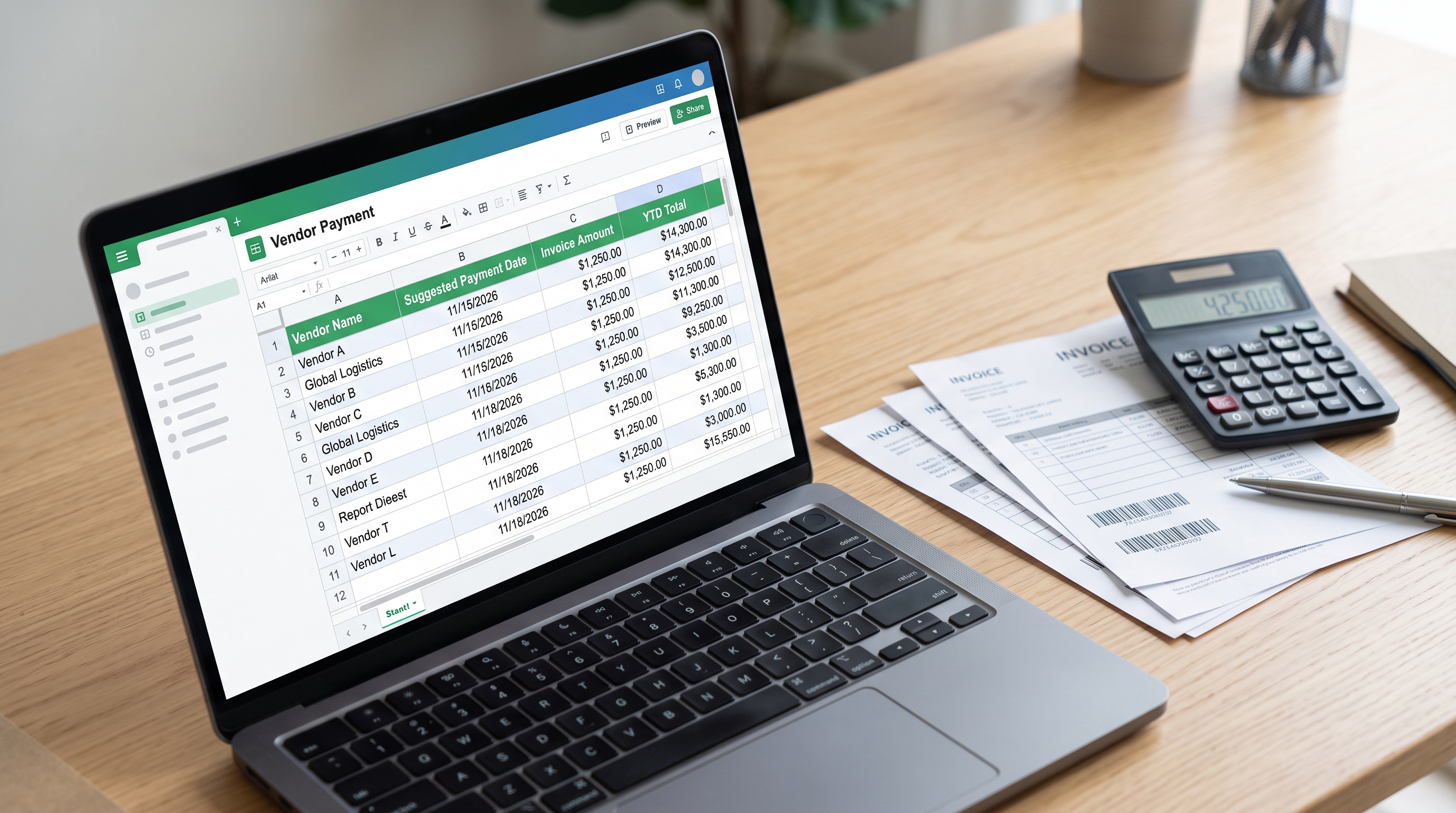
Then maintain a contractor payment tracker. A spreadsheet can work well if you have only a few contractors, while your bookkeeping or accounting software may provide a more efficient solution as your business grows.
Your tracker could include:
Information to track | Why it matters |
|---|---|
Contractor's legal name | Helps identify the correct recipient |
Business name and tax classification | Supports reporting decisions |
W-9 received | Identifies missing documentation |
Total payments | Helps determine reporting requirements |
Payment methods | Helps identify payments subject to different reporting rules |
Invoices and supporting records | Provides documentation for your expenses |
1099 status | Tracks preparation, delivery, and filing |
Review the tracker monthly or quarterly rather than waiting until year-end.
This habit also supports better bookkeeping because contractor expenses are easier to review, categorize, and reconcile throughout the year.
Your Year-End Contractor Checklist
Before closing out the year, take a few minutes to work through this list:
Identify everyone you paid for services during 2026.
Request missing W-9s.
Securely store contractor information.
Reconcile contractor payments to your bookkeeping records.
Review payment methods and identify transactions subject to different reporting rules.
Determine which contractors require an information return under the rules applicable to 2026 payments.
Resolve discrepancies in names, addresses, taxpayer identification information, and payment totals.
Confirm the filing and recipient delivery deadlines.
Establish a process for tracking contractor information going forward.
If you need help determining which payments are reportable, consult a qualified tax professional. The checklist is a starting point, not a substitute for reviewing the rules that apply to your business.
Make Year-End Easier by Starting Now
Hiring contractors can be a great way to grow your business without taking on every task yourself. But paying people to help you run your business comes with recordkeeping responsibilities, too.
By reviewing your contractor list, collecting W-9s, reconciling payments, and understanding the applicable 1099 rules before year-end, you can make the filing process more manageable and reduce last-minute surprises.
And here's one simple step you can take today: Pull a report of everyone you paid through your business this year and identify which contractor records are missing. You don't have to finish everything in one sitting. Just start with that list.
How does your business currently keep track of contractor payments? Do you collect W-9s when you first hire someone, or does that task tend to wait until tax season? Share your approach in the comments. Your process might give another business owner a helpful idea!
At C-Squared Accounting, we believe understanding your numbers and staying organized throughout the year can help you make more confident financial decisions. A little preparation today can make a meaningful difference when year-end arrives.