IRS Standard Mileage Rate 2026: Guide for Self-Employed Business Owners
IRS Standard Mileage Rate 2026: Complete Guide for Self-Employed Business Owners
Welcome to Insights: Beyond the Numbers, where we simplify tax, accounting, and financial strategies so business owners can make informed decisions with confidence. Whether you're looking to reduce your tax bill, improve cash flow, or better understand your numbers, you'll find practical insights you can apply to your business. Let's start with one of the most well-known tax deductions that you're probably not taking full advantage of, vehicle mileage.

If you're self-employed and use your personal vehicle for work, the IRS standard mileage rate for 2026 could be one of the simplest ways to reduce your tax bill.
Whether you're a mobile pet groomer, veterinarian making house calls, dog walker, consultant, real estate professional, or another small business owner who spends time on the road, every business mile you track could translate into valuable tax savings.
For 2026, the IRS increased the business mileage rate, giving many business owners a larger deduction than last year. But claiming the deduction isn't just about multiplying your miles by the IRS rate. You'll also need to determine whether the standard mileage method or the actual expense method provides the larger tax benefit for your situation.
In this guide, you'll learn:
The 2026 IRS standard mileage rate
Who qualifies to use it
What counts as business mileage
How to keep an IRS-compliant mileage log
Standard mileage vs. actual expenses
Which deduction method may save you the most money
Common mistakes to avoid
Whether you own a pet care business or another type of small business, understanding these rules can help you maximize one of your most valuable tax deductions.
What Is the IRS Standard Mileage Rate for 2026?
The 2026 IRS standard mileage rate for business use is 72.5 cents per mile, effective January 1, 2026. This is an increase from 70 cents per mile in 2025.
The IRS also announced these rates for 2026:
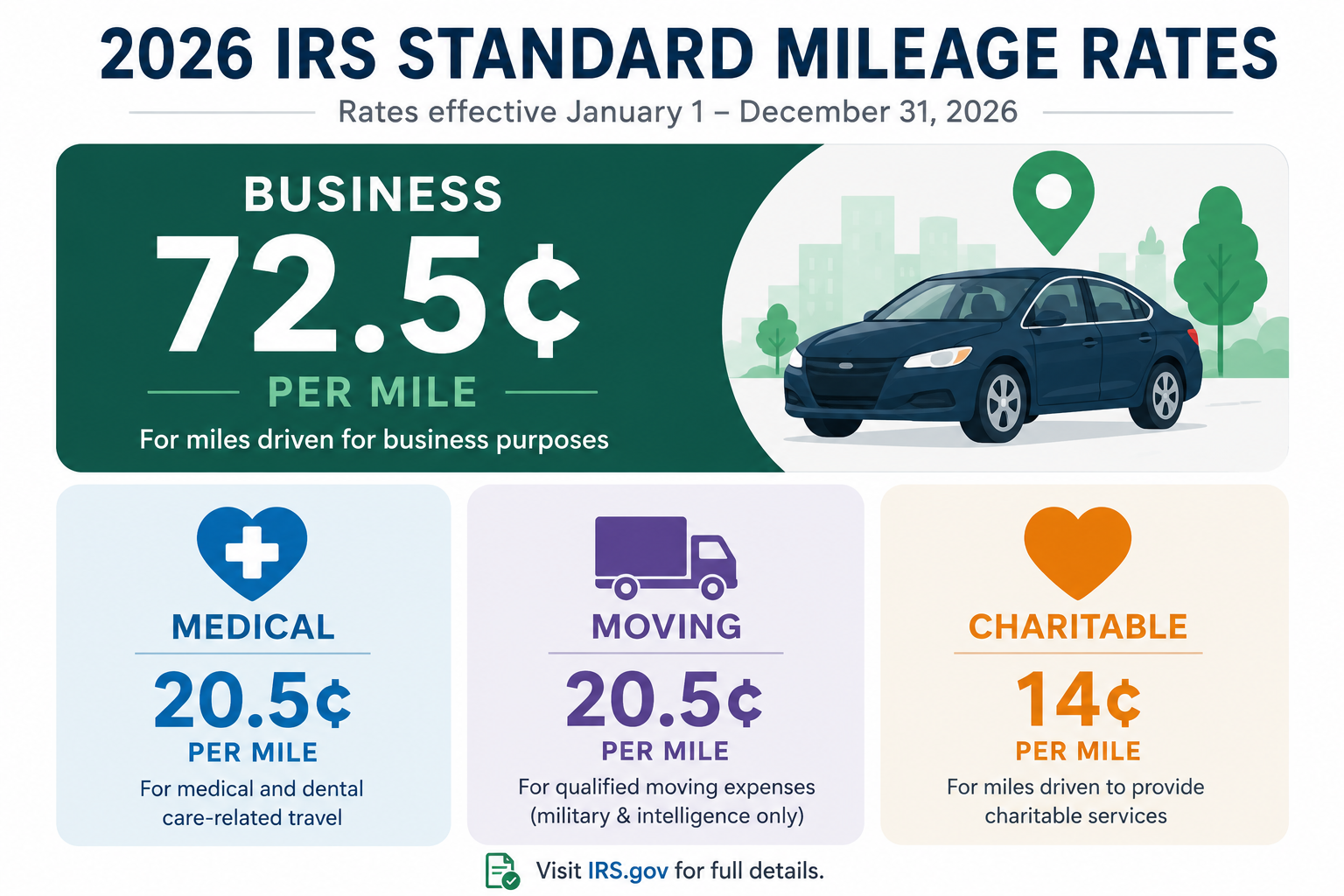
The business mileage rate applies whether you drive a gas-powered, hybrid, diesel, or electric vehicle.
Rather than tracking every dollar spent on gas, oil changes, insurance, and repairs, the standard mileage method allows you to deduct a fixed amount for every qualifying business mile you drive.
Who Can Use the Standard Mileage Deduction?
Most self-employed taxpayers qualify, including:
Sole proprietors
Independent contractors
Freelancers
Single-member LLC owners
Consultants
Small business owners
This deduction is especially valuable for businesses that spend significant time on the road, such as:
Mobile pet groomers
Pet sitters
Dog walkers
Mobile veterinarians
Trainers
Home service businesses
Realtors
Contractors
What Counts as Business Mileage?
Generally, deductible business mileage includes driving between:
Client appointments
Multiple work locations
Vendors
Supply stores
Banks
The post office
Business meetings
Conferences
Continuing education
Temporary work locations
For example, if a pet sitter drives from one client's home to another before stopping at a pet supply store to purchase business supplies, those miles generally qualify as business mileage.
What Doesn't Count?
Not every mile you drive for work-related reasons is deductible.
Generally, you cannot deduct:
Your regular commute
Personal errands
Family trips
Vacation travel
Driving between home and a permanent office
Keeping business and personal driving separate makes claiming the deduction much easier.
How to Calculate Your Mileage Deduction
The calculation is straightforward.
Business Miles × IRS Mileage Rate = Deduction
Example:
You drive 8,500 business miles during 2026.
8,500 × $0.725 = $6,162.50
That could mean a $6,162.50 business deduction without tracking every gas receipt throughout the year.
Best Ways to Track Business Mileage
The IRS expects you to maintain accurate, contemporaneous records of your business travel. Reconstructing your mileage months later using your calendar or memory usually isn't enough if your return is questioned.
A complete mileage log should include:
Date
Starting location
Destination
Business purpose
Total miles driven
Many business owners now use GPS-based mileage tracking apps that automatically record trips.
Popular options include:
MileIQ
Everlance
Driversnote
TripLog
QuickBooks Mileage
For example, a dog walker visiting eight clients each day can have every trip automatically tracked instead of recreating routes months later during tax season.
Whatever tracking method you choose, consistency is the key.
Standard Mileage vs. Actual Expense Method: Which Is Better?
One of the most common questions business owners ask is:
Should I use the standard mileage deduction or the actual expense method?
The answer depends on your vehicle, operating costs, and business use.
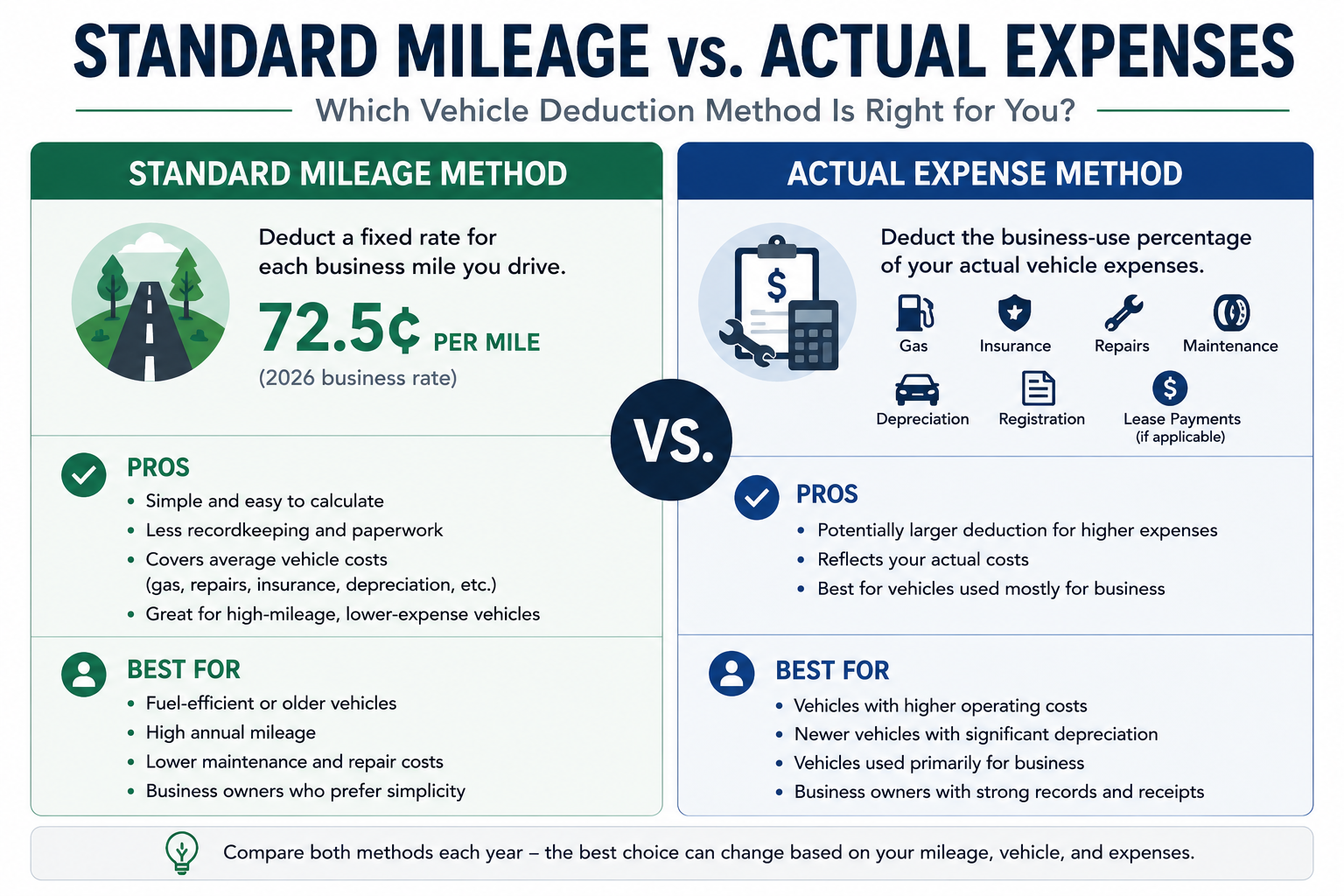
Standard Mileage Method
With this method, you deduct a fixed amount for every qualifying business mile driven.
It often works best if you:
Drive a fuel-efficient vehicle
Have relatively low maintenance costs
Drive many business miles
Prefer simple recordkeeping
Actual Expense Method
Instead of using the IRS mileage rate, you deduct the business-use percentage of your actual vehicle costs.
These may include:
Gas
Insurance
Repairs
Maintenance
Tires
Registration fees
Lease payments
Depreciation (for owned vehicles)
This method often benefits business owners with higher operating costs or vehicles used primarily for business.
Example
Imagine two business owners each drive 18,000 business miles during the year.
A mobile dog groomer driving a reliable five-year-old van may receive a larger deduction using the standard mileage method.
A veterinarian driving a newer SUV with higher insurance, maintenance, and depreciation costs may benefit more from the actual expense method.
Because every business is different, comparing both methods each year can help maximize your tax savings.
Important IRS Rules to Know
A few IRS rules catch business owners by surprise.
Choose Carefully in the First Year
If you own your vehicle, using the standard mileage method in the first year generally preserves your ability to switch methods in future years. Starting with certain actual expense methods can limit that flexibility.
If you lease your vehicle and choose the standard mileage method, you'll generally need to continue using it for the life of the lease.
Keep Good Records
Mileage estimates aren't enough.
The IRS expects documentation that supports:
Business purpose
Dates
Miles driven
Personal Miles Don't Count
Only miles driven for legitimate business purposes qualify for the deduction.
Common Mistakes to Avoid
Business owners often lose deductions by:
Guessing annual mileage
Forgetting to track trips
Claiming commuting miles
Mixing business and personal travel
Losing receipts when using actual expenses
Automatically choosing the same deduction method every year
Avoiding these mistakes can save both money and stress if you're ever audited.
Frequently Asked Questions
Can I deduct commuting miles?
Usually, no.
Driving between your home and your regular place of business is considered commuting and is generally not deductible.
Can I switch between the standard mileage and actual expense methods?
Sometimes.
The IRS allows certain changes depending on how the vehicle was first placed into business service. Choosing the right method during the first year is especially important.
Do I need receipts if I use the standard mileage method?
You don't need fuel receipts to calculate your deduction, but you should still keep records for parking fees, tolls, and a detailed mileage log.
Can I deduct mileage for more than one vehicle?
Yes.
If you use multiple personal vehicles for business, you can generally deduct qualified business mileage for each one, provided you maintain accurate records.
What if I forgot to keep a mileage log?
You may still be able to reconstruct some trips using calendars, client appointments, invoices, or GPS history, but contemporaneous records are much more reliable and better support your deduction in the event of an IRS audit.
Is mileage deductible for LLC owners?
Yes.
Single-member LLCs, sole proprietors, independent contractors, and many other self-employed business owners can qualify for the business mileage deduction if they meet IRS requirements.
How Pet Businesses Can Maximize Vehicle Deductions
Vehicle expenses are often one of the largest tax deductions available for businesses in the pet industry.
Mobile groomers, pet sitters, dog walkers, trainers, and mobile veterinarians can all accumulate thousands of business miles throughout the year.
Because vehicle expenses can represent a significant deduction, choosing the right method and keeping accurate records can make a noticeable difference in your annual tax savings.
Need Help Choosing the Best Method?
The best vehicle deduction isn't always the most obvious one.
While the standard mileage method is simpler, the actual expense method may produce a larger deduction depending on your vehicle, mileage, and operating costs.
At C-Squared Accounting, we help self-employed business owners compare both methods each year so they can confidently choose the option that provides the greatest legitimate tax savings. We have particular expertise working with pet care businesses, where driving is often a major part of daily operations.
Final Thoughts
The 2026 IRS standard mileage rate of 72.5 cents per mile offers many self-employed business owners an easy way to deduct vehicle expenses while simplifying recordkeeping.
However, the standard mileage method isn't automatically the best choice for everyone. Reviewing your options each year and maintaining accurate mileage records throughout the year can help ensure you're maximizing your deduction while staying compliant with IRS rules.
Whether you own a pet care business or another small business, taking a proactive approach to vehicle deductions can put more money back into your business and reduce surprises at tax time.