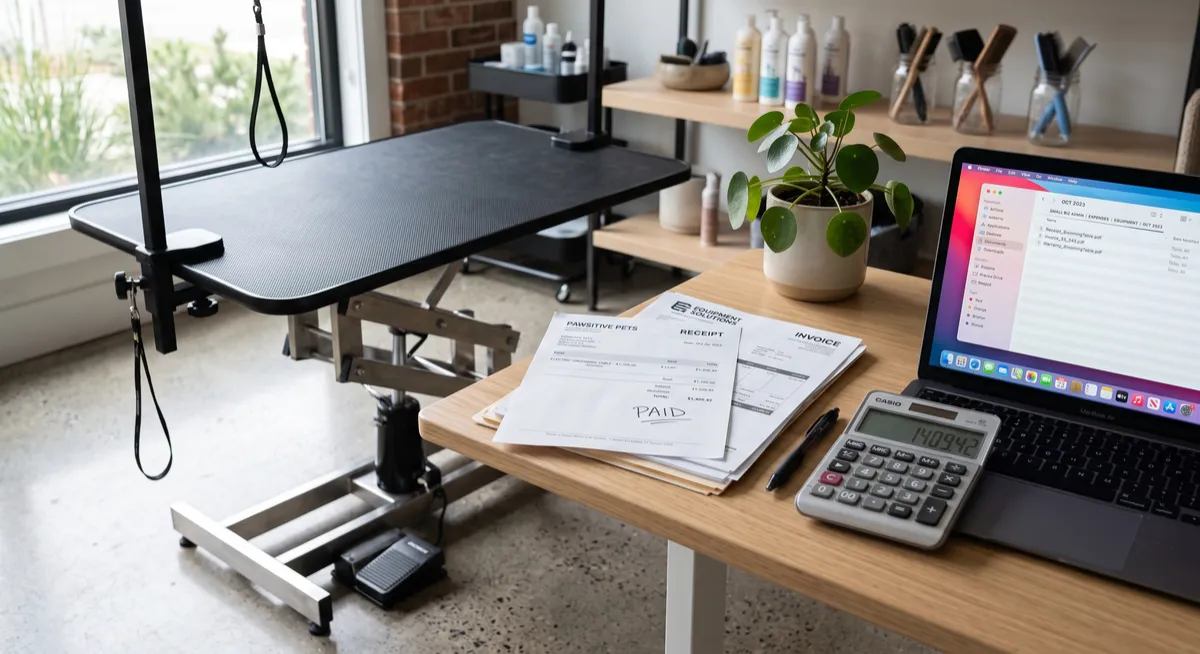
Bought Equipment for Your Business? Track This.
Buying equipment for your business can feel like a milestone.
Maybe you finally replaced that aging computer. You purchased a commercial-grade printer, added new grooming equipment, upgraded your photography setup, or invested in equipment that allows you to serve more customers.
And then you put the receipt away and move on.
But when tax time rolls around, that purchase can become much more important than you realized.
The equipment itself is only part of the story. The records you keep about the purchase can help determine how it is treated for tax purposes and make your tax return much easier to prepare.
If you've purchased equipment for your business this year, here's what you should be tracking and why those records matter.
What Counts as Business Equipment?
For tax purposes, equipment generally refers to property you purchase and use in your business that is expected to last longer than a short period of time.
Examples might include:
Computers and laptops
Printers and other office equipment
Machinery
Commercial furniture
Tools
Cameras and photography equipment
Grooming equipment
Specialized pet-care equipment
Business vehicles
Certain technology and production equipment
Not every purchase will be treated the same way for tax purposes, though.
That's why simply recording "equipment for $3,000" in your bookkeeping system isn't always enough.
You want to preserve the details that allow you or your tax professional to determine the appropriate tax treatment.
7 Things to Track When You Buy Equipment
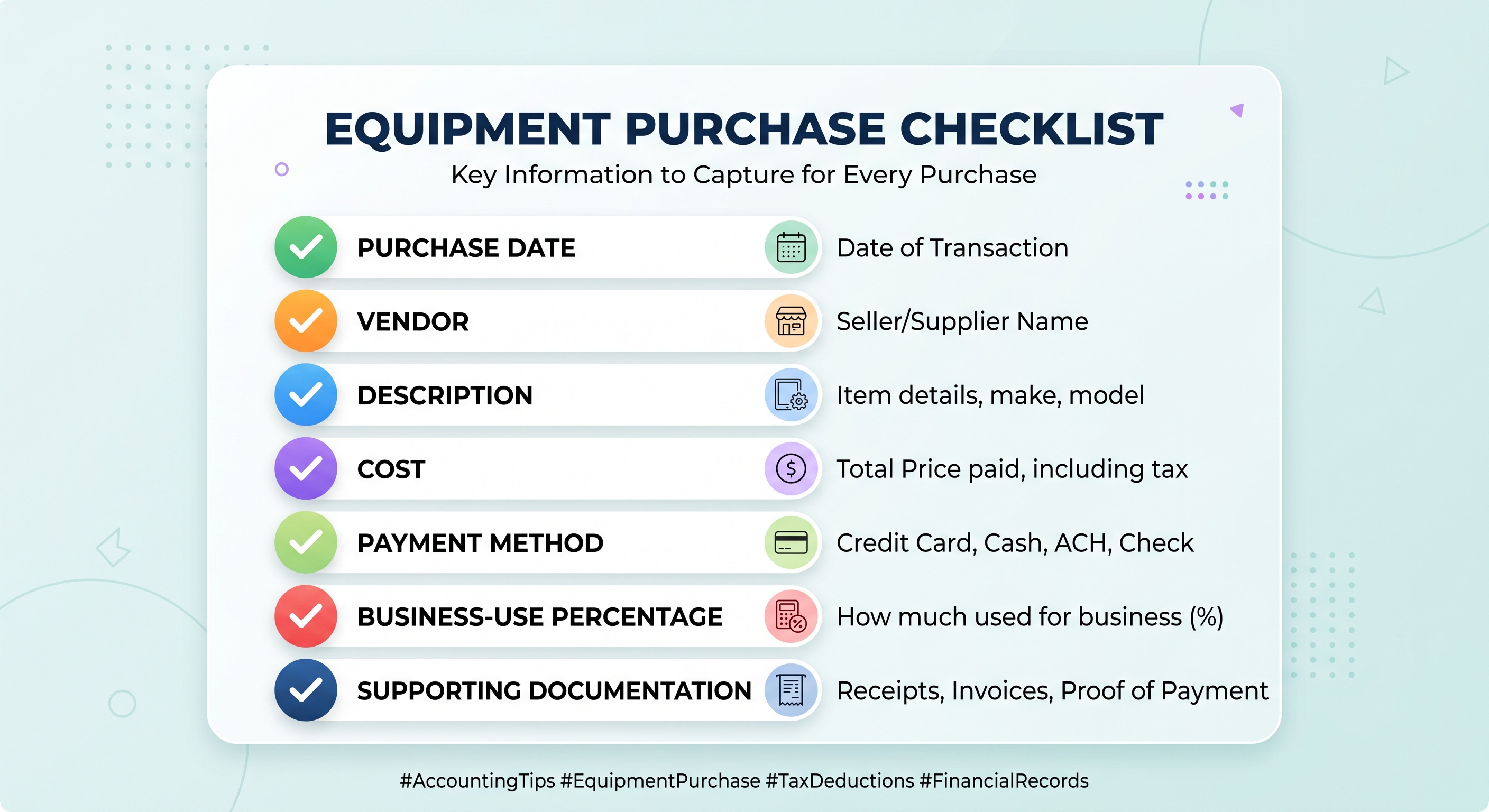
Here's the information I recommend keeping for every significant equipment purchase.
1. What Did You Buy?
Be specific.
Instead of recording:
Equipment — $4,500
Record something more descriptive, such as:
Commercial grooming table and hydraulic lift
The description helps you identify the asset later and makes your records much more useful during tax preparation.
2. When Did You Buy It?
Keep the purchase date.
This matters because the timing of an equipment purchase can affect which tax year it belongs to and whether certain tax provisions may apply.
There's an important distinction between when you ordered something, when you paid for it, and when it was placed in service.
Your tax professional may need those details when determining the appropriate treatment.
3. How Much Did It Cost?
Keep the complete purchase price and supporting documentation.
That means saving:
The invoice
Receipt
Sales tax information
Shipping or delivery charges
Installation costs, when applicable
Other costs associated with acquiring the asset
Don't rely solely on the transaction appearing in your bank or credit card account.
A bank statement might tell you that you spent $5,000 at a vendor. It doesn't necessarily tell you what you purchased or what the $5,000 included.
4. Who Did You Buy It From?
Keep the vendor or seller's information.
This is another small detail that's easy to overlook but useful when you're trying to reconstruct a purchase months later.
Your invoice or receipt will typically provide this information.
5. How Did You Pay?
Document whether the equipment was purchased with:
Cash
Business checking
Credit card
Financing
A business loan
Another payment arrangement
If you financed the equipment, keep the financing documents, too.
The purchase price of the equipment and the financing costs are not necessarily treated the same way for tax purposes.
6. How Much Do You Use It for Business?
This one is particularly important when an asset has both business and personal use.
For example, suppose you purchase a computer that you use 80% for your business and 20% personally.
That business-use percentage may matter when determining the amount of an expense or depreciation that is eligible for business treatment.
The same concept can become especially important with assets such as vehicles.
Don't wait until tax time to try to remember how much you used an asset for business.
Keep records throughout the year.
7. Keep the Supporting Documents
This is perhaps the most important part.
Save the documents that support the purchase, including:
Invoices
Receipts
Purchase agreements
Financing documents
Credit card receipts
Proof of payment
Warranty information
Documentation showing business use
Ideally, store these electronically in a place where you can find them later.
A folder called "2026 Equipment Purchases" is a lot more useful than digging through your inbox in March trying to find a receipt from July.
Buying Equipment Doesn't Always Mean "Write It Off"
Here's where things can get a little more complicated.
You might hear someone say:
"I bought equipment, so I can deduct the whole thing."
That's not necessarily true.
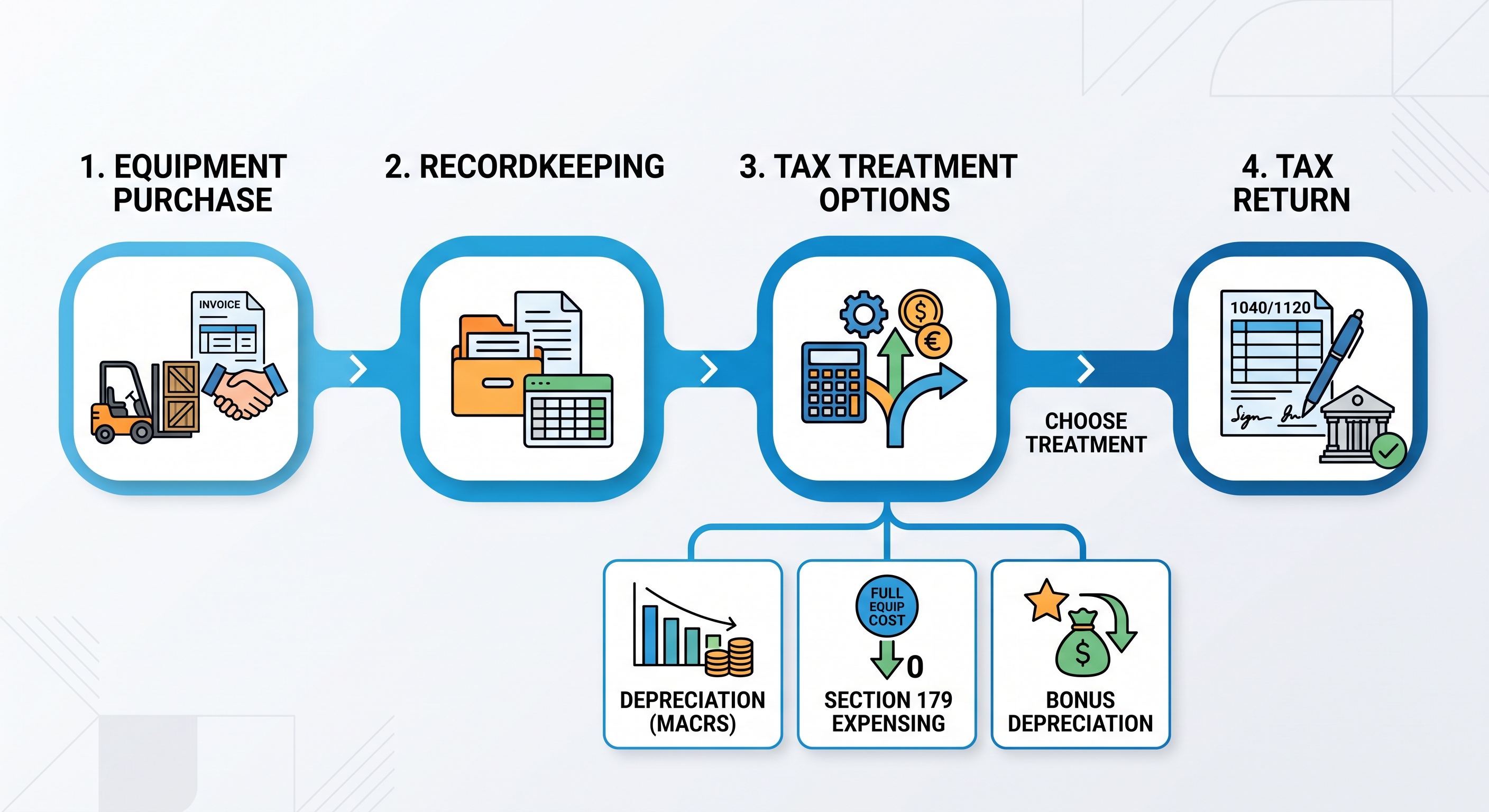
Depending on the type of property, when it was placed in service, how it is used, and other factors, the cost may potentially be handled through depreciation, Section 179, bonus depreciation, or another applicable tax treatment.
Tax laws and eligibility requirements can also change.
That's why the purchase price alone doesn't tell the whole story.
Your tax professional needs enough information to determine the appropriate treatment based on your specific situation.
An Example
Let's say your business purchases $8,000 of equipment.
If you only record:
Equipment — $8,000
you've captured the amount of the transaction, but not necessarily everything your tax preparer may need.
A better record might include:
Information | Example |
|---|---|
Equipment | Commercial grooming equipment |
Purchase date | July 15, 2026 |
Cost | $8,000 |
Vendor | ABC Equipment Co. |
Payment method | Business credit card |
Business use | 100% |
Placed in service | July 20, 2026 |
Documentation | Invoice + proof of payment |
Now you have a much more complete picture.
And that information can make a big difference when it's time to prepare your tax return.
Why Year-End Equipment Records Matter
Here's something many business owners don't think about until December or worse, tax season.
Your bookkeeping records and your tax records need to work together.
At year-end, your tax professional may need to identify purchases that should be reviewed as potential fixed assets rather than ordinary operating expenses.
If you don't have a clear record of what you purchased, when you purchased it, and how it is being used, you may end up spending unnecessary time reconstructing the information.
That could mean:
Searching through emails
Digging through receipts
Reviewing credit card statements
Calling vendors
Trying to remember when something was purchased
Figuring out which equipment is still in use
And nobody wants to spend January doing that.
A Simple Year-End Equipment Review
Before the year ends, take 15–30 minutes to review your books and ask:
Did we purchase any equipment this year?
Are those purchases properly categorized?
Do we have the invoices or receipts?
Do we know when each item was purchased and placed in service?
Was any equipment financed?
Does any equipment have personal and business use?
Did we sell, trade in, or dispose of any existing equipment?
That last question is important, too.
Your records shouldn't only reflect what you bought. If you sold, traded in, or disposed of business equipment, make sure that information is recorded and communicated to your tax professional.
Don't Forget About Equipment You Already Own
Year-end is also a good time to look at the equipment you purchased in previous years.
If you've been in business for several years, you may have equipment that is still sitting on your books.
Ask yourself:
Is the equipment still being used?
Was it sold or disposed of?
Was it traded in?
Is it still in the business?
Has anything changed about how it is being used?
These changes can matter for your accounting and tax records.
Make Equipment Tracking Part of Your Routine
You don't need an elaborate system.
A simple spreadsheet or fixed-asset list can work well.
At a minimum, consider tracking:
Date | Description | Vendor | Cost | Payment Method | Business Use | Placed in Service | Documentation
Then save the supporting documents in an organized digital folder.
The goal isn't to create more paperwork.
The goal is to make sure that when you or your tax professional need the information, you can actually find it.
The Bottom Line
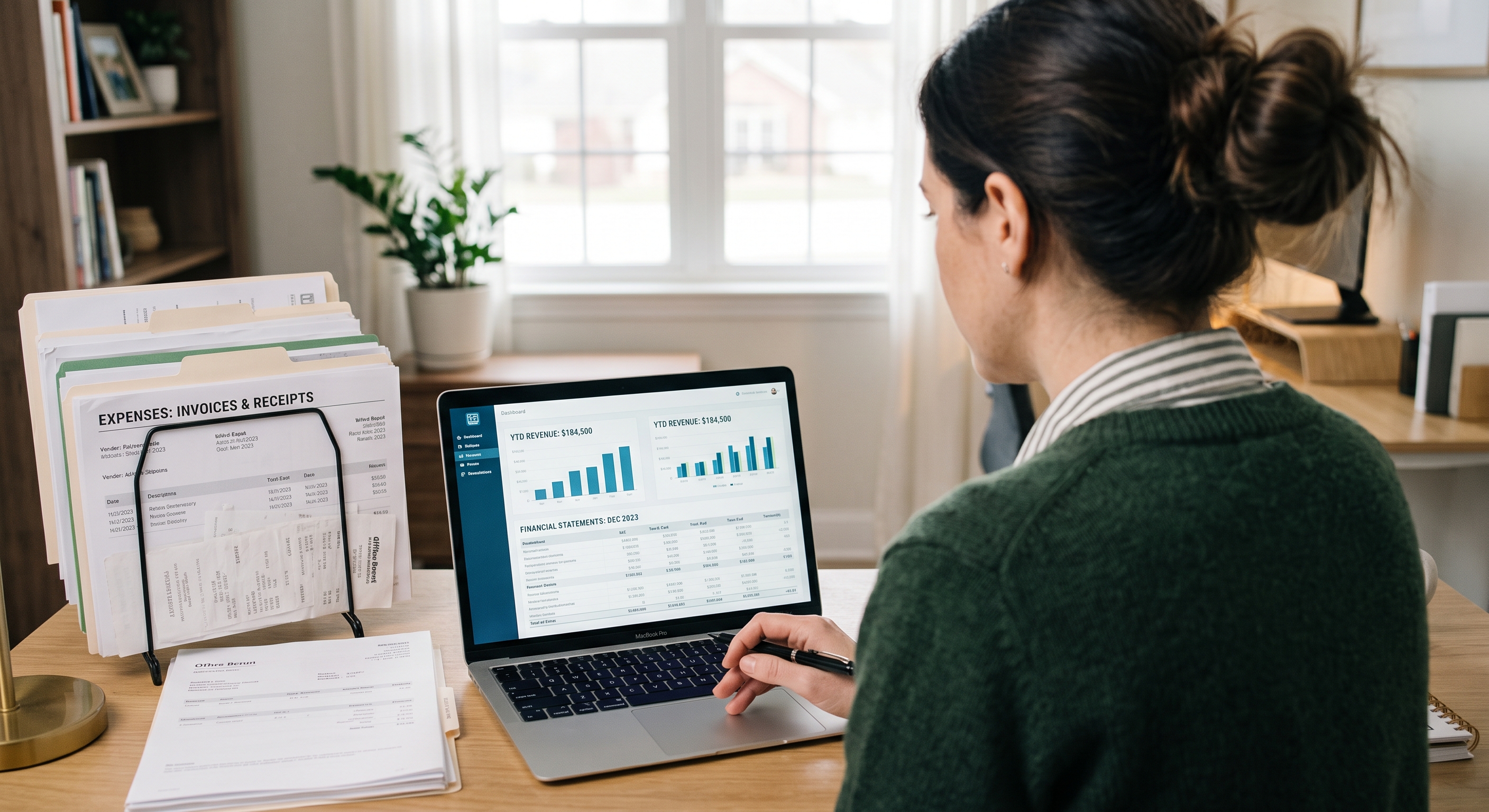
Buying equipment can be an important investment in your business.
But don't let the excitement of the purchase end when the equipment arrives.
Track the details. Save the documentation. Review your equipment records before year-end.
Good records can help your tax professional determine the appropriate tax treatment, reduce the time spent tracking down information, and help you avoid missing important details when preparing your return.
And remember: a receipt in your inbox isn't a recordkeeping system.
Take a few minutes now to create or update your equipment tracking list. Your future self and your tax preparer will thank you.
Have you purchased equipment for your business this year? Take 15 minutes this week to gather your receipts, invoices, and purchase details and make sure they're all in one place.
Need clarification for anything, visit c-squaredaccounting.com to contact us.