
Estimated Taxes: Should You Adjust Your Payments?
Your business had a great quarter. Revenue is up, profits are growing, and things are finally starting to feel predictable.
Then you remember:
Your next estimated tax payment is coming due.
And you start wondering, "Wait...should I still be paying the same amount I paid last quarter?"
The answer is: maybe not.
Estimated tax payments are based on what you expect your tax liability to be not simply on what you paid last year or what you originally estimated at the beginning of the year.
If your business income, expenses, deductions, or personal tax situation has changed significantly, it may be time to revisit your estimated payments.
Here's how to know when and why you should make an adjustment.
What Are Estimated Tax Payments?
If you're self-employed or own a pass-through business, you may need to make payments toward your federal income tax throughout the year.
These payments are generally made quarterly and are intended to cover taxes you expect to owe when you file your tax return.
Your estimated tax calculation may include more than just federal income tax. Depending on your situation, it could also account for things like:
Self-employment tax
Tax on business income passed through to you
Investment or other taxable income
State income taxes
Tax credits and deductions
The goal isn't necessarily to predict your tax return down to the dollar.
The goal is to pay enough throughout the year to avoid an unexpected tax bill and potentially avoid an estimated tax penalty.
What Happens If Your Income Changes?
This is where things get interesting for small business owners.
Unlike employees who typically have taxes withheld from each paycheck, business owners often have to estimate their tax liability and send payments themselves.
But business income isn't always predictable.
You might have:
A significant increase in sales
A slow season
A large new client
Higher operating expenses
A major equipment purchase
Changes in payroll
A new business deduction
A change in your business structure
A spouse who started or changed jobs
A change in filing status
A new dependent
Investment or other income
All of these things can potentially affect your overall tax liability.
That means the estimated payment you calculated six months ago may no longer be the right number.
When Should You Consider Adjusting Your Estimated Payments?
You don't necessarily need to recalculate your taxes every time your revenue changes.
Instead, look for meaningful changes that could affect your taxable income or overall tax liability.
Here are a few situations that should trigger a tax-planning conversation.
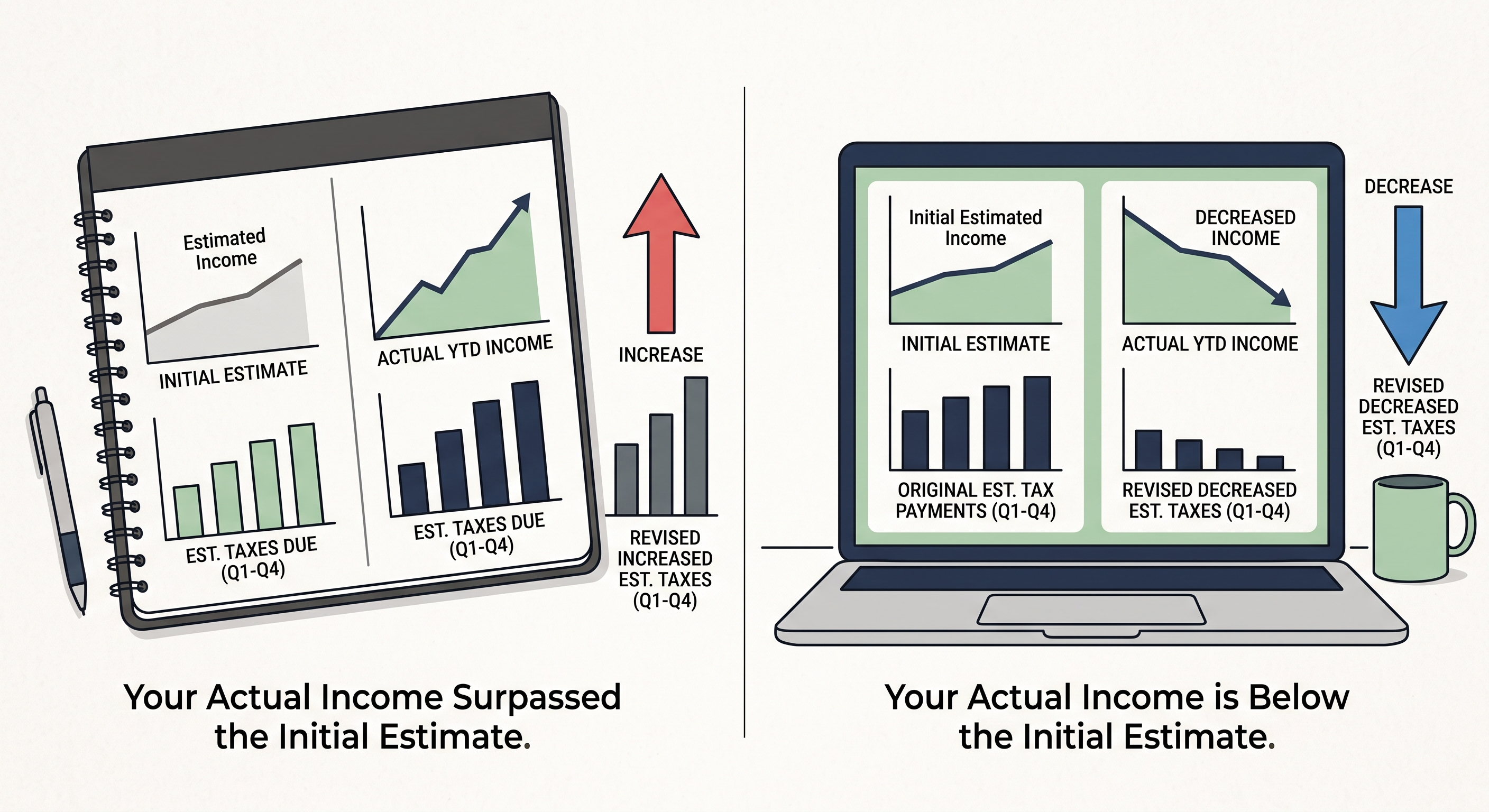
1. Your Business Income Increased
Let's say you originally projected $200,000 of business profit for the year.
Six months into the year, you're on pace to generate $300,000.
That's a significant change.
If your expenses haven't increased enough to offset the additional income, your tax liability could be substantially higher than originally projected.
Simply continuing to make your original quarterly payments could leave you with a large balance due at tax time.
2. Your Business Income Decreased
The opposite can happen, too.
Maybe you expected a strong year, but sales slowed down.
If your taxable income is going to be significantly lower than originally projected, continuing to send large estimated payments may mean you're giving the IRS more money than necessary throughout the year.
While you'll generally receive credit for those payments when you file your return, there may be better uses for that cash in the meantime.
For a small business owner, cash flow matters.
3. Your Business Expenses Changed
Revenue isn't the only number that matters.
Suppose your revenue increased, but you also:
Hired employees
Increased contractor costs
Moved into a larger facility
Purchased business equipment
Increased marketing expenses
Added new software or technology
Experienced other significant deductible expenses
Your taxable profit may not have increased as much as your revenue suggests.
That's why looking at profit not just revenue is critical when evaluating estimated tax payments.
4. You Had a Major Tax Deduction or Tax Credit
Tax planning opportunities can also change your estimated payment calculation.
For example, you may make retirement contributions, purchase qualifying business property, or become eligible for a tax credit.
These changes could reduce your projected tax liability.
But here's the important part:
Don't assume a deduction automatically means you should reduce your estimated payments.
Your overall tax situation needs to be considered before making that decision.
5. Your Personal Tax Situation Changed
Your business isn't the only thing that affects your tax bill.
If you're a business owner filing jointly, your household income matters too.
For example, your estimated tax liability could change if your spouse:
Started a new job
Received a significant raise
Changed employers
Retired
Started a business
Had different withholding than expected
Changes in dependents, filing status, investment income, or other sources of income can matter as well.
Don't Make the Mistake of Looking Only at Revenue
One of the biggest mistakes I see business owners make is thinking:
"My revenue went up 20%, so my taxes must have gone up 20%."
Not necessarily.
Taxes are generally based on taxable income, not simply gross revenue.
Consider this simplified example:
Original Projection | Updated Projection | |
|---|---|---|
Revenue | $250,000 | $300,000 |
Expenses | $100,000 | $140,000 |
Business Profit | $150,000 | $160,000 |
Revenue increased by $50,000 but profit only increased by $10,000.
That's why your estimated tax payment shouldn't be adjusted based solely on your top-line revenue.
You need to understand what's happening with profit and taxable income.
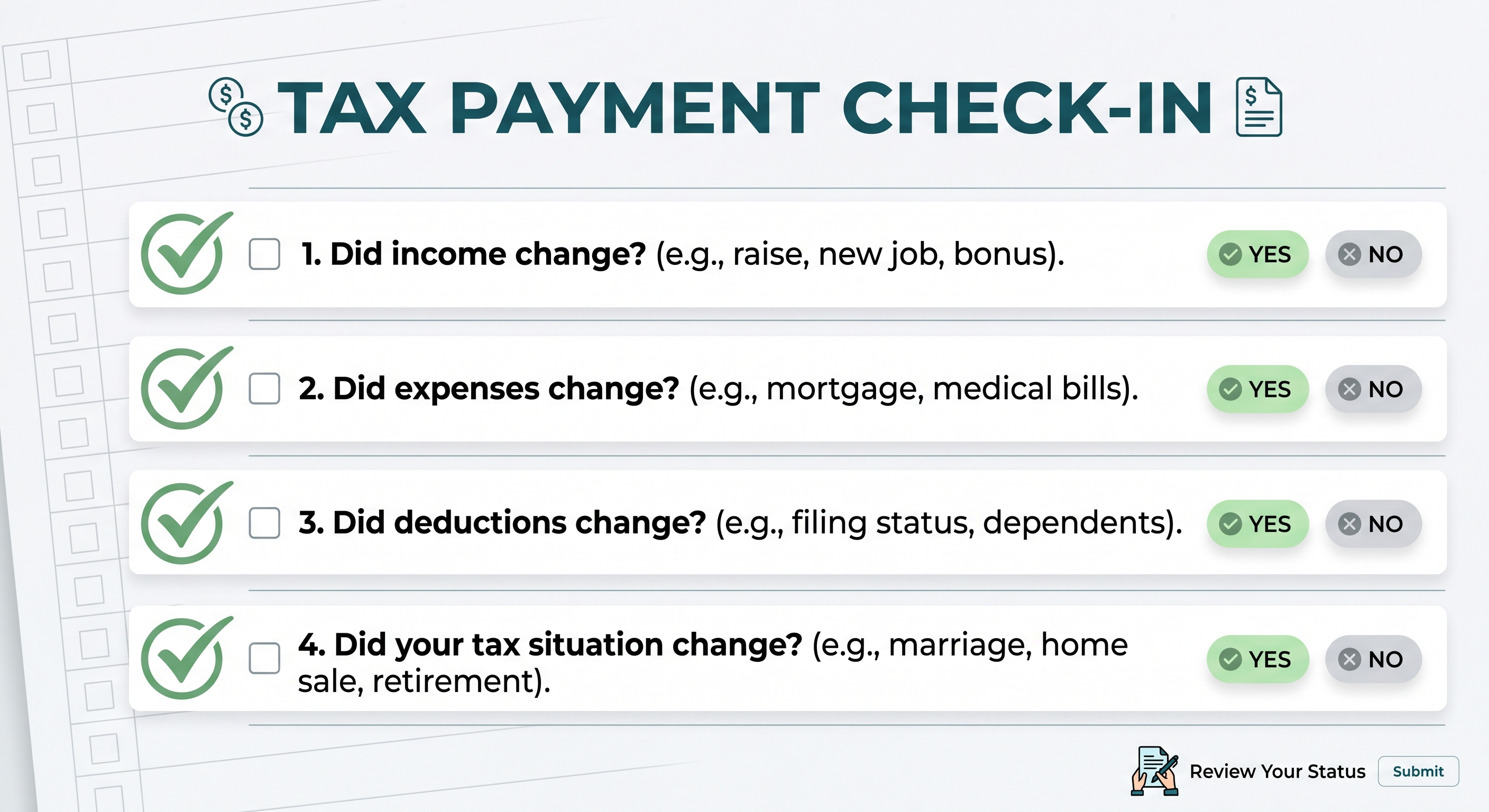
A Simple Quarterly Tax Check-In
You don't have to wait until tax season to determine whether your estimated payments are still appropriate.
Instead, build a simple tax check-in into your quarterly financial routine.
Step 1: Review Your Year-to-Date Profit
Start with your actual year-to-date financial results.
Look at:
Revenue
Cost of goods sold, if applicable
Operating expenses
Net profit
Make sure your bookkeeping is up to date before using these numbers for tax planning.
Step 2: Estimate Your Full-Year Income
Your year-to-date numbers are only part of the picture.
Consider what you expect to happen during the remainder of the year.
Ask yourself:
"Based on what I know today, what do I realistically expect my business to earn for the entire year?"
Don't simply annualize your current numbers if your business is seasonal.
Step 3: Consider Major Changes
Think beyond your P&L.
Have there been any significant changes to:
Your business structure?
Payroll?
Retirement contributions?
Equipment purchases?
Vehicle use?
Health insurance?
Your spouse's income?
Dependents?
Other income?
These details can change the tax calculation.
Step 4: Recalculate Your Projected Tax Liability
Once you have updated income and deductions, you can estimate your expected tax liability for the year.
Then compare that amount with:
Estimated tax payments already made
Federal withholding
Applicable credits
Other payments toward your tax liability
This gives you a better idea of whether your remaining payments should stay the same, increase, or decrease.
Step 5: Make the Adjustment
If your tax planning shows that your current payments are too low, you may need to increase future payments.
If you're significantly overpaying, you may be able to reduce future payments provided the calculation supports doing so without creating an underpayment issue.
The key is to make the adjustment based on updated numbers rather than guesswork.
What About the Estimated Tax Penalty?
This is an important distinction:
Owing money at tax time isn't automatically the same thing as owing an estimated tax penalty.
The IRS has rules that can allow taxpayers to avoid an underpayment penalty if they meet certain requirements, commonly involving paying enough during the year based on current-year tax or prior-year tax.
But "I won't get penalized" and "I won't owe a large tax bill" are two very different things.
You can potentially avoid an estimated tax penalty and still owe thousands of dollars when you file your return.
That's why I don't recommend using the penalty rules as your tax-planning strategy.
The goal should be to plan for your actual tax liability not simply to pay the minimum amount necessary to avoid a penalty.
The Bigger Picture: Estimated Taxes Are a Cash Flow Tool
Here's the perspective I want business owners to adopt:
Estimated tax payments aren't just an IRS requirement. They're part of your cash-flow planning.
When you know approximately how much you'll need to set aside for taxes, you can make better decisions about the money remaining in your business.
Instead of:
"I made $20,000 this month! I can spend $20,000!"
You can think:
"I made $20,000. How much needs to be reserved for taxes, and how much is actually available to use?"
That distinction can make a significant difference in how confidently you manage your business.
Your Income Changed. Now What?
If your business income has changed significantly this year, don't automatically keep making the same estimated payment or panic and send a huge check to the IRS.
Take a step back and review the full picture.
Ask:
What is my year-to-date profit?
What do I realistically expect to earn for the full year?
Have my expenses or deductions changed?
Has my personal or household income changed?
How much have I already paid toward my tax liability?
What should I set aside for the remainder of the year?
Those answers can help you determine whether your estimated payments are still on track.

Conclusion: Don't Let Your Tax Payments Run on Autopilot
Your business doesn't stay the same throughout the year.
Your income changes. Your expenses change. Your goals change. And sometimes, your personal financial situation changes too.
Your tax payments should be flexible enough to account for those changes.
A quarterly tax check-in can help you avoid two common problems: being caught off guard by a large tax bill or unnecessarily tying up cash that your business could use.
So before you make your next estimated tax payment, take a look at your numbers.
Your future self and your bank account will thank you.
Ready to Make Your Numbers Work Harder?
Don't wait until tax season to find out whether you're on track.
Review your numbers, update your projections, and make tax planning part of your regular business routine.
If you're not sure what your updated tax picture looks like, talk with your CPA or tax professional before changing your estimated payments.
And if this post helped you, share it with another business owner who might be making estimated tax payments based on last year's numbers.